Gold Futures (XAUUSD) Cup and Handle Analysis | April 2026
The following technical analysis is based on data as of April 2, 2026.
Gold futures (XAUUSD) closed at $4,702.70, down $80.50 (-1.68%) from the previous session. Gold has staged a remarkable rally in 2026, breaking through the $5,000 milestone in early February and reaching a period high of $5,586.20. However, a correction phase followed, with prices dropping to $4,100.80 in mid-March. The market is now in recovery mode, with the last five sessions showing a gradual uptrend: $4,492.00 → $4,526.00 → $4,647.60 → $4,783.20 → $4,702.70. On April 2, despite "Liberation Day" tariff announcements and heightened Middle East tensions around Iran, dollar strength overrode safe-haven gold buying, pushing prices lower.
■ Technical Indicators: Current Position
Moving averages show SMA5 at $4,630.30, SMA25 at $4,862.28, SMA75 at $4,783.61, and SMA200 at $4,116.38. The current price of $4,702.70 remains well above the SMA200, confirming the long-term uptrend remains intact. However, the deviation from SMA25 is -3.28% and from SMA75 is -1.69%, indicating the price is somewhat oversold on a medium-term basis. The RSI (14-day) stands at 47.12, sitting in neutral territory with a slight bearish lean. Notably, the MACD reads -105.31 against a signal line of -107.49, with the histogram at +2.18 — turning positive. This is a significant signal suggesting momentum may be bottoming out. Stochastics at K=65.65 and D=61.85 are positioned in the upper half of the neutral zone, supporting the recovery of short-term buying pressure.
■ Bollinger Bands and Volatility
The Bollinger Bands (20-day, 2σ) show an upper band at $5,357.23, middle band at $4,786.96, and lower band at $4,216.69. The bandwidth of 23.83% is extremely wide, reflecting very high market volatility. The current price sits slightly below the middle band. The Ichimoku Cloud analysis shows the tenkan-sen at $4,463.35 and kijun-sen at $4,752.90, with the price positioned inside the cloud. While the cloud itself is bearish, the price being inside the cloud signals indecision — the direction of the eventual breakout will be crucial.
■ Chart Pattern Analysis: Cup and Handle
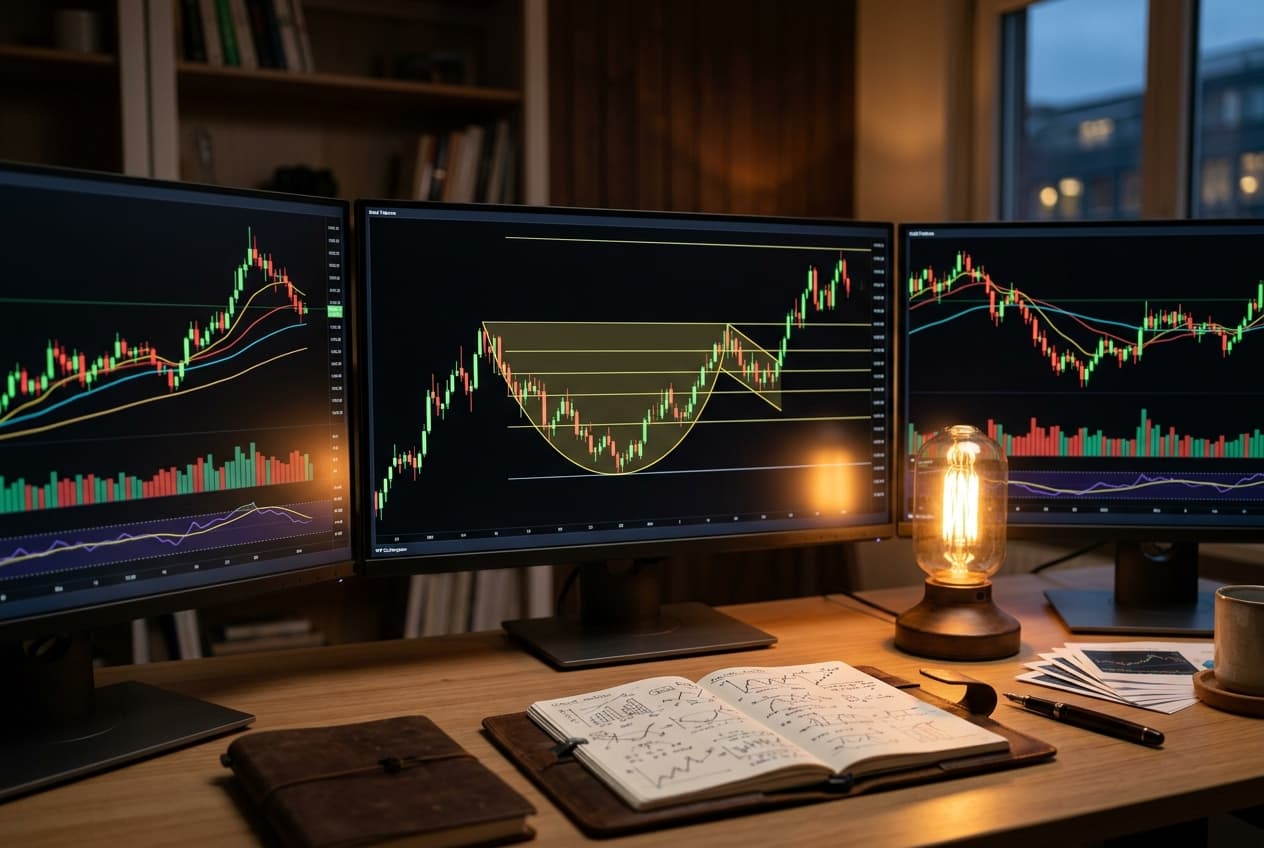
Gold futures are showing early signs of a cup-and-handle pattern formation. The left lip of the cup corresponds to the period high of $5,586.20 (late January/early February). The cup bottom sits at the period low of $4,100.80 (mid-March). Since then, prices have recovered gradually: $4,100.80 → $4,492.00 → $4,526.00 → $4,647.60 → $4,783.20 → $4,702.70, tracing a U-shaped recovery over approximately two weeks. The gradual U-shape rather than a sharp V-shape aligns with textbook cup-and-handle formation criteria. The current price is near the Fibonacci 38.2% retracement level of $4,668.22, suggesting the right side of the cup is still forming. The "handle" portion would typically develop as a smaller pullback near the right lip, around the $5,000–$5,500 area. According to Thomas Bulkowski's research, cup-and-handle patterns have a success rate of approximately 61% with an average post-breakout rise of 34%.
■ Support and Resistance Levels
Key Fibonacci retracement levels are: 23.6% at $4,451.35, 38.2% at $4,668.22, 50% at $4,843.50, 61.8% at $5,018.78, and 78.6% at $5,268.32. Pivot point analysis shows the pivot at $4,703.00, R1 at $4,825.60, R2 at $4,948.50, S1 at $4,580.10, and S2 at $4,457.50. The $5,000 psychological level is critically important — breaking this round number would be key to completing the right side of the cup.
■ Volume and Market Sentiment
Trading volume on April 2 reached 186,430 contracts, a staggering 12.89 times the 20-day average volume of 14,459. This massive volume increase during the cup's recovery phase suggests strong institutional accumulation. The VIX has surged 35% since the start of the year, with equity market instability driving safe-haven demand into gold. Over the past year, gold has gained approximately $1,528, reflecting continued expansion of institutional gold allocations.
■ Key Catalysts and Market Environment
The "Liberation Day" tariffs announced on April 2 could significantly alter the global trade order, representing a medium-to-long-term tailwind for gold. Geopolitical risks in the Middle East surrounding Iran are elevating safe-haven demand. Central bank gold purchases remain strong even at these elevated price levels, indicating sustained structural demand. Major investment banks are projecting further upside — Goldman Sachs targets $5,400/oz by year-end 2026, while JP Morgan forecasts $6,300/oz. Multi-timeframe analysis shows daily and weekly uptrends with a strong monthly uptrend, though there is a misalignment between daily and monthly trend strength.
■ Outlook and Scenarios
Bullish scenario: The right side of the cup completes, a "handle" pullback forms near $5,000–$5,500, and the price breaks above the $5,586.20 neckline. Based on Bulkowski's statistics, the pattern target would be approximately $7,500 (+34%). The MACD histogram turning positive and rising stochastics support this direction. Bearish scenario: A decisive break below the Fibonacci 38.2% level ($4,668.22) and support at S1 ($4,580.10) and S2 ($4,457.50) would invalidate the cup formation, risking a retest of the $4,100.80 low. The neutral RSI of 47.12 and price within the Ichimoku cloud suggest direction is not yet confirmed. Neutral scenario: Price consolidates in the $4,500–$5,000 range as the right side of the cup takes several weeks to form. With Bollinger Band width at 23.83%, the high-volatility environment could produce significant price moves at any time.
■ Summary
Gold futures are in the early stages of a potential cup-and-handle pattern following a correction from the all-time high of $5,586.20. Positive signals are accumulating — the MACD histogram turning positive, a 12.89x volume surge, and bullish forecasts from major banks. However, as indicated by the price sitting inside the Ichimoku cloud and the neutral RSI, more time is needed to confirm direction. The progress of the cup's right side recovery and a recapture of the $5,000 level will be the key factors to watch.
Disclaimer: This article is an analysis based on technical indicators and does not constitute a recommendation to buy or sell any financial instrument. All investment decisions should be made at your own risk.