S&P 500 Chart Analysis: Rectangle Consolidation (April 2026)
The following technical analysis is based on data as of April 2, 2026.
The S&P 500 has officially entered correction territory in 2026, declining over 10% from its peak amid escalating tariff policies and slowing GDP growth. On April 2, the index closed at 6,582.69 (+7.37, +0.11%), posting a modest rebound. However, the daily timeframe remains in a strong downtrend, while weekly and monthly timeframes maintain their uptrends. This multi-timeframe divergence has produced a clear rectangle (consolidation) pattern. In this article, we examine the key technical indicators and outline potential scenarios ahead.
■ Technical Indicators: Current Position
Reviewing moving averages from longest to shortest: the SMA200 stands at 6,644.60, SMA75 at 6,818.20, SMA25 at 6,657.36, and SMA5 at 6,479.82. The current closing price of 6,582.69 sits below all major moving averages, indicating a short-to-medium-term bearish bias. The deviation from SMA25 is -1.12%, while the deviation from SMA75 is -3.45%, showing widening divergence from the medium-term trend.
The 14-day RSI reads 46.18—not yet in oversold territory (below 30) but positioned on the slightly bearish side of the neutral zone. The key development is in the MACD (-84.88) versus its signal line (-88.80): the MACD histogram has turned positive at +3.92, an early signal suggesting momentum may be bottoming out. However, with the MACD still deep in negative territory, it is premature to confirm a trend reversal.
Stochastic oscillators show K=60.76 and D=56.08, sitting in neutral territory without a decisive directional signal.
■ Bollinger Bands and Volatility
The Bollinger Bands (20-day, 2σ) show an upper band at 6,853.70, middle band at 6,607.84, and lower band at 6,361.98, with a bandwidth of 7.44%. The current price of 6,582.69 sits just below the middle band. After bouncing from near the lower band around 6,361.98 on March 30, the middle band at 6,607.84 now serves as the immediate resistance level. The 7.44% bandwidth suggests elevated volatility persists.
■ Chart Pattern Analysis
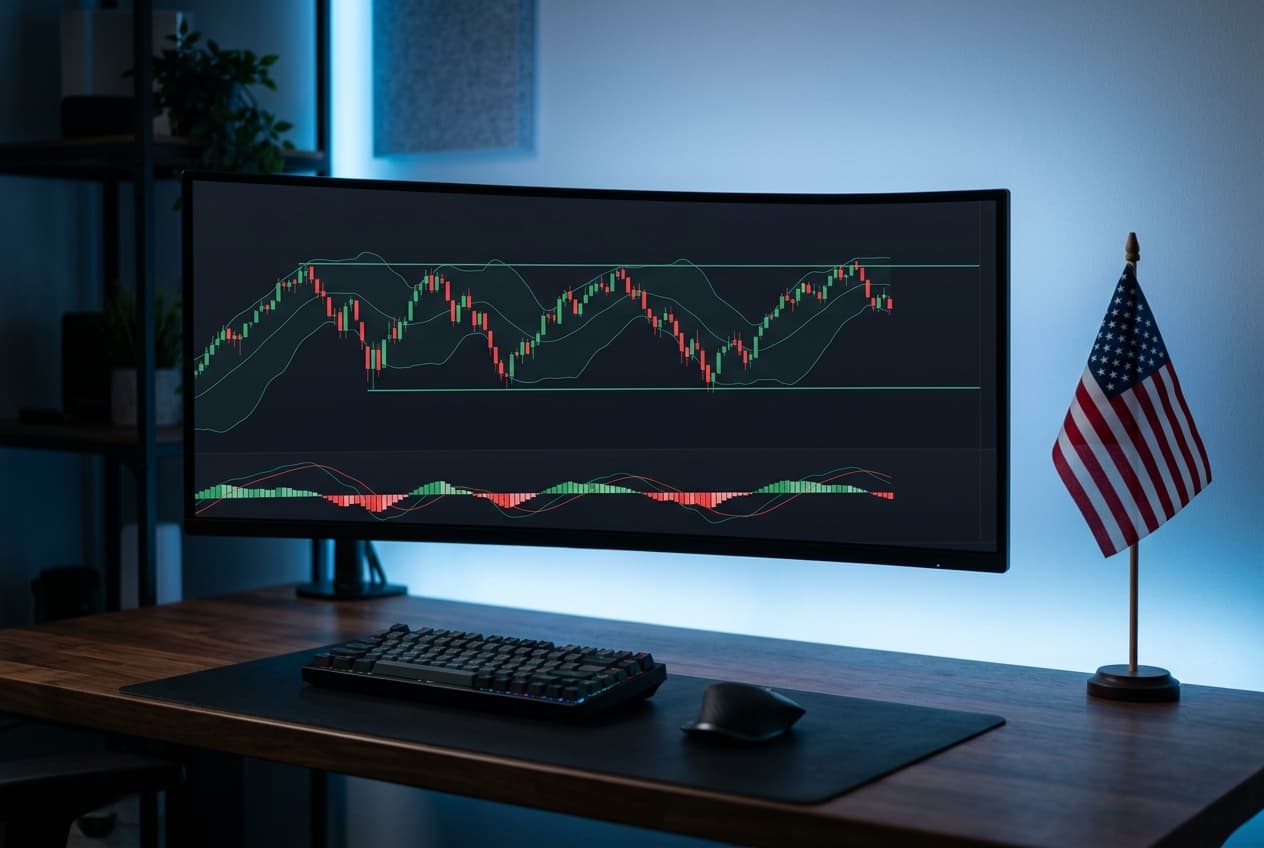
The S&P 500 has formed a well-defined rectangle (box range) pattern. The lower boundary sits near the period low of 6,316.91 (recorded on March 30), while the upper boundary aligns with the SMA25 area around 6,657.36. The price action tells the story: on March 27, the index dropped to 6,356, testing the lower bound. On March 30, it touched 6,317, establishing the floor. It then rebounded to 6,528 on March 31, followed by 6,575 on April 1 and 6,582 on April 2, trading in the middle of the range.
This rectangle pattern is a product of the compression between the daily strong downtrend and the weekly/monthly uptrends. The current price nearly coincides with the Fibonacci 38.2% retracement level (6,578.72) and sits inside the Ichimoku cloud (which has a bearish configuration). The tenkan-sen is at 6,484.26 and the kijun-sen at 6,632.08, with price trapped between these two lines. This convergence zone will likely determine the direction of the eventual breakout.
■ Support and Resistance Levels
Pivot point analysis yields a central pivot at 6,553.18, with R1 at 6,631.42, R2 at 6,680.15, S1 at 6,504.45, and S2 at 6,426.21. Key Fibonacci levels include the 23.6% retracement at 6,478.66 (short-term support), the 38.2% at 6,578.72 (current price zone), the 50% at 6,659.59 (medium-term recovery target), and the 61.8% at 6,740.47. A sustained break above 61.8% would signal a return to the broader uptrend.
■ Volume and Market Sentiment
Volume on April 2 was 4.74 billion shares, below the 20-day average of 5.79 billion (ratio of 0.82). This below-average volume reflects a wait-and-see approach by market participants. In rectangle patterns, declining volume is a classic precursor to breakouts. A subsequent move accompanied by a volume surge—in either direction—would serve as confirmation. Continued low-volume trading within the range suggests further consolidation.
■ Key Catalysts and Market Environment
On the macro front, US tariff rates on imports have surged to approximately 12% in 2026 (up from about 2% at the start of 2025). The Yale Budget Lab estimates the effective rate at 14.3% after consumer adjustments. Goldman Sachs reports that US companies and consumers have absorbed 82% of tariff costs, with 67% expected to fall on consumers by mid-2026. Manufacturing activity has contracted for nine consecutive months, and US GDP grew just 2.2% in 2025—the slowest pace since the COVID recession.
On the positive side, the April 1 rally was driven by Trump's hint at early withdrawal from Iran, along with stronger-than-expected ADP employment, retail sales, and ISM data. However, the Liberation Day tariffs announced on April 2 have added fresh uncertainty. Historically, there is a 70% probability of correction during midterm election years, adding political risk to the equation.
■ Outlook and Scenarios
[Bullish Breakout] If the index decisively breaks above the SMA25 at 6,657.36 and the Fibonacci 50% level at 6,659.59 with increasing volume, it would confirm an upward rectangle breakout. Targets would include the Fibonacci 61.8% at 6,740.47 and the Bollinger upper band at 6,853.70. The weekly/monthly uptrends and the positive MACD histogram shift support this scenario.
[Bearish Breakdown] A break below the period low of 6,316.91 would confirm a downward breakout. This could open the path toward 6,200 and lower. The daily strong downtrend, additional tariff impacts, and continued manufacturing contraction are the primary risk factors. A volume spike accompanying the decline would warrant heightened caution.
[Range Continuation] If the low-volume environment persists without major economic or policy surprises, the 6,317-6,660 range may extend further. The neutral RSI and mid-range Stochastic readings suggest no immediate directional resolution.
■ Summary
The S&P 500 is trading within a rectangle pattern between 6,317 and 6,660, at the intersection of a daily downtrend and weekly/monthly uptrends. The positive shift in the MACD histogram and the stabilization near the Fibonacci 38.2% level hint at improving short-term momentum. However, tariff uncertainty and manufacturing weakness cap the upside. Prudent position management is advised until the breakout direction is confirmed.
*This article is for informational purposes only and does not constitute investment advice. All investment decisions should be made at your own risk.*