S&P 500 Chart Analysis (April 17, 2026): Three White Soldiers Breakout to Record Highs, RSI 73.18 Overheat Warning
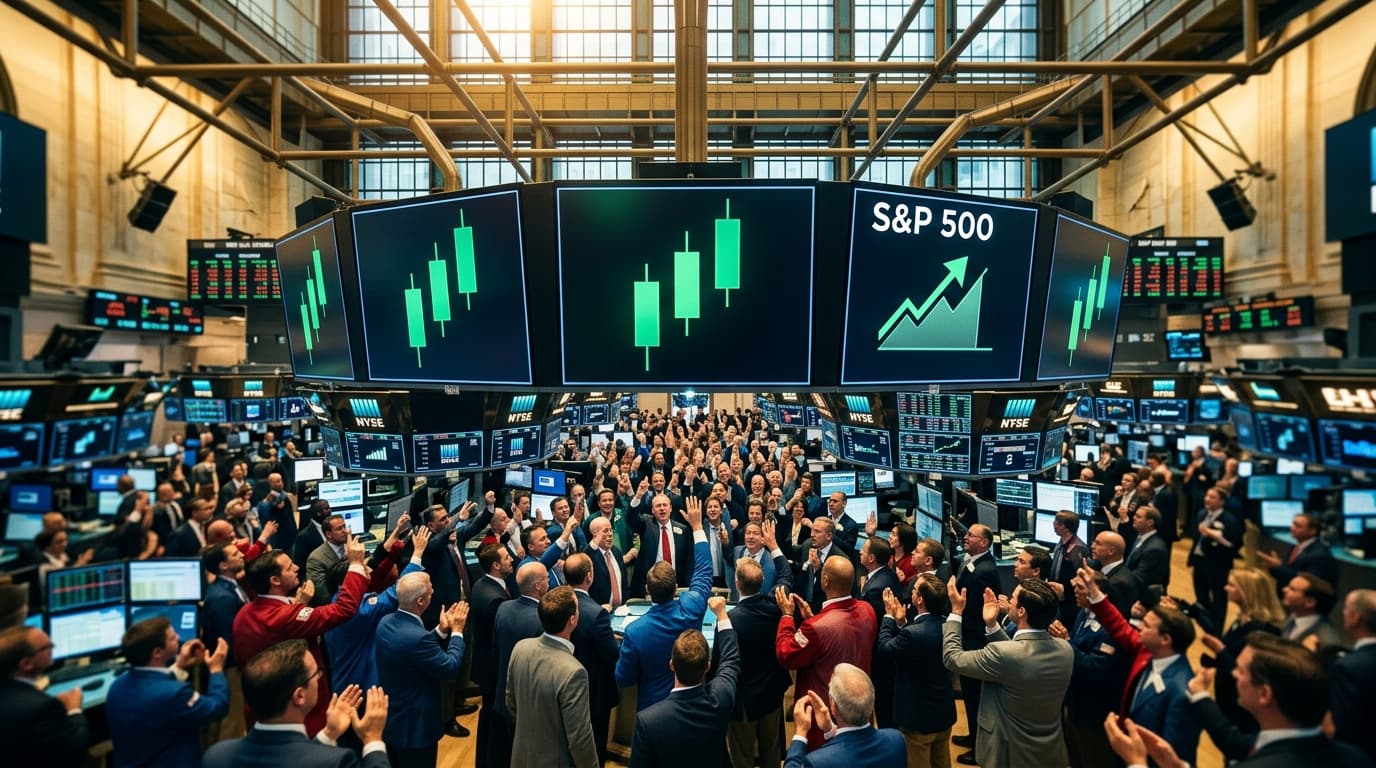
The S&P 500 closed at 7,126.06 on April 17, 2026, rising 84.78 points (+1.20%) and posting its best week since May 2025. It is the first time the index has closed above 7,100 — a new all-time-high zone. The rally is a V-shaped recovery driven by the April 8 US-Iran two-week ceasefire mediated by Pakistan: VIX has dropped ~41% from its war-peak to 17.48 (-2.56% on the day), while the 10-year Treasury yield sits at 4.26%. This article examines the "Three White Soldiers" pattern that appeared on April 13-15 and the resulting overheated conditions. The following technical analysis uses script output dated April 17, 2026.
■ Technical Indicators: Current Position
Moving averages: SMA5 stands at 7,008.78, SMA25 at 6,683.51, SMA75 at 6,820.78, and SMA200 at 6,683.79. Price (7,126.06) is above all of them, confirming bullish bias. However, the ordering is SMA5 > SMA75 > SMA200 > SMA25 — unusual because the V-shaped decline to the period low of 6,316.91 pulled SMA25 lower than SMA75. Deviation from SMA25 is +6.62% (above the +5% overheat threshold) and +4.48% from SMA75.
RSI(14) reads 73.18, crossing above the 70 overbought threshold. MACD is 89.14 with its signal line at 23.52 and a +65.62 histogram — strong bullish momentum well above the zero line. The Ichimoku cloud is bullish (Senkou A 6,786.62 > Senkou B 6,732.22), price sits above the cloud, and the chikou line is above the body — all components aligned bullishly.
■ Bollinger Bands and Volatility
The upper band is at 7,134.59, middle at 6,690.45, and lower at 6,246.31, with bandwidth of 13.28% — an exceptionally expanded state reflecting the V-shaped recovery since April 8. Price at 7,126.06 is only 8.53 points below the upper band, placing it in the top 2.5% statistically — a clear overheat zone. Traders must assess whether a "band walk" will develop or whether mean-reversion pressure will take over.
■ Chart Pattern Analysis: Three White Soldiers
Reviewing the last five sessions reveals a textbook "Three White Soldiers" pattern on April 13-15. The pattern consists of three consecutive strong bullish candles, each closing near its high and above the prior close — a classic bullish reversal/continuation signal from Japan's Sakata methodology.
Specifically: April 13 opened at 6,806.47 and closed at 6,886.24 (+69.35) near the high of 6,887.00 (gap between close and high: 0.76). April 14 opened at 6,910.20 (a +23.96 gap-up from the prior close), closed at 6,967.38 (+81.14) against a high of 6,969.42. April 15 opened at 6,978.17 (+10.79 gap-up), closed at 7,022.95 (+55.57) against a high of 7,026.24, crossing the 7,000 psychological round number on a closing basis. Volumes stepped up from 4.786 billion to 5.032 billion to 5.279 billion shares — a stair-stepping increase that strengthens the pattern's reliability.
After the three soldiers completed, April 16 produced a small-body consolidation (+3.50 body, 29.26 lower wick, 9.95 upper wick). April 17 then printed a bullish marubozu-type candle (open = low = 7,074.55, close = 7,126.06) driving price to a new period high of 7,147.52. The "three soldiers → brief pause → breakout" sequence is a textbook bullish continuation. According to Bulkowski's Encyclopedia of Chart Patterns, Three White Soldiers emerging after a downtrend have an approximately 82% reversal success rate (based on US market data; results may vary in other markets). Learn more about this pattern on the Chart Master pattern detail page.
■ Support and Resistance Levels
Pivot-point analysis: pivot at 7,116.04, R1 at 7,157.54, R2 at 7,189.01, S1 at 7,084.57, S2 at 7,043.07. The period high is today's 7,147.52. The cluster between the Bollinger upper band (7,134.59) and R1 (7,157.54) forms an immediate 7,135-7,157 resistance zone. Fibonacci retracement (from period low 6,316.91 to period high 7,147.52) shows 100% already recovered, with 78.6% at 6,969.77, 61.8% at 6,830.23, and 50% at 6,732.22 as step-by-step pullback candidates. Psychologically, 7,000 is key support and 7,200 is the next bullish target.

■ Volume and Market Sentiment
Volume on April 17 was 6.145 billion shares against a 20-day average of 5.437 billion (ratio 1.13x) — above-average participation accompanying the rally. Combined with the rising volume during the three-soldiers formation (4.79B → 5.03B → 5.28B), this confirms sustained demand. However, Stochastic readings are extreme: %K at 97.42 and %D at 98.53 — both far above the 80 overbought threshold. The index sits at 97.42% of the period range (6,316.91-7,147.52), implying non-trivial reversal risk. VIX at 17.48 (-2.56%) continues to decline, confirming elevated risk appetite.
■ Market Drivers and Context
The primary catalyst for the V-shaped recovery is the April 8 US-Iran two-week ceasefire mediated by Pakistan. Post-ceasefire, Brent crude has dropped ~15% to $90.38/barrel (lowest since March 10), easing inflation expectations. On the earnings front, Goldman Sachs, JPMorgan, Citi, and Morgan Stanley reported strong Q1 results during the week of April 13, and TSMC reported +35% YoY revenue on April 16. FactSet projects S&P 500 Q1 EPS growth of +12.5% YoY — the sixth consecutive double-digit quarter, with the IT sector expected at +44%.
Macro: March CPI released April 10 at +3.3% YoY; the Fed funds rate remains on hold at 3.50-3.75%. The next FOMC is April 28-29, with markets pricing a hold followed by 1-2 cuts later in 2026. The Iran ceasefire is described as a "pause, not a resolution," so the risk of Strait of Hormuz disruption re-emerging remains.
■ Outlook and Scenarios
[Bullish Scenario] A volume-supported break above R1 (7,157.54) would open up the Bollinger upper band (7,134.59) and R2 (7,189.01) as next targets, with the 7,200 psychological round number in sight. Monthly-timeframe analysis confirms a "strong uptrend," supporting the broader bull case. Better-than-expected Q1 earnings or a dovish FOMC could sustain the momentum.
[Bearish Scenario] Extreme overheat (Stoch %K/%D 97.42/98.53, price at upper band) could trigger profit-taking. A break below S1 (7,084.57) would expose S2 (7,043.07) and the 7,000 psychological level clustered with SMA5 (7,008.78) — a 7,000-7,043 support zone. Below 7,000, Fibonacci 78.6% at 6,969.77 would come into play. Ceasefire breakdown, weak tech earnings, or a CPI re-acceleration could be triggers.
[Neutral Scenario] Time-based consolidation within 7,000-7,150 while overheated indicators cool off. SMA5 (7,008.78) catching up to price could form fresh support. Daily and weekly timeframes remain classified as "downtrend" while the monthly is "strong uptrend" — alignment is false, reflecting directional uncertainty.
■ Summary
The S&P 500 surged to a new all-time-high zone of 7,126.06 via the April 13-15 three white soldiers and the April 17 breakout — technicals are bullish. However, RSI 73.18, Stochastic K/D 97.42/98.53, and the Bollinger upper-band touch flag real overheat, making short-term pullback risk non-trivial. Key levels: downside at 7,000 (psychological) and S2 at 7,043.07; upside at R1 7,157.54 and R2 7,189.01. The April 28-29 FOMC, the mid-stage of Q1 earnings season, and the durability of the US-Iran ceasefire will define the direction.
*This article is for informational purposes only and does not constitute a recommendation to buy or sell any financial instrument. Investment decisions should be made at your own risk. Technical indicator values are based on analysis-script output as of April 17, 2026.*