WTI Crude Breaks $112: Ascending Channel Under Pressure [Apr 2026]
![WTI Crude Breaks $112: Ascending Channel Under Pressure [Apr 2026]](/_next/image?url=%2Fcolumns%2Fwti-ascending-channel-2026-04%2Fcover.png&w=3840&q=75)
The following technical analysis is based on data as of April 2, 2026.
WTI crude oil futures surged $11.94 (+11.93%) on April 2, 2026, closing at $112.06 — the highest level since 2022. The dramatic move was triggered by escalating military tensions with Iran threatening the Strait of Hormuz, through which approximately 20% of the world's oil supply passes. Goldman Sachs estimates the geopolitical risk premium at $14–18 per barrel. Over the past five trading sessions, prices moved from 99.64 to 102.88, 101.38, 100.12, and finally 112.06, with the final day delivering an explosive breakout.
■ Technical Indicators: Current Position
Moving averages are in perfect order: SMA5 at 103.22, SMA25 at 91.25, SMA75 at 71.08, and SMA200 at 65.99 — all aligned bullishly from short to long term, confirming a strong uptrend. Price deviation from SMA25 stands at +22.81%, indicating significant overextension. RSI(14) reads 71.43, having crossed into overbought territory. MACD sits at 7.61 above its signal line of 7.11, with the histogram at 0.51 remaining positive. Multi-timeframe analysis shows strong uptrends across daily, weekly, and monthly charts with full alignment.
■ Bollinger Bands and Volatility
The Bollinger Bands show an upper band at 107.90, middle at 95.63, and lower at 83.37, with bandwidth expanded to 25.65% — reflecting a sharp increase in volatility. At 112.06, price has decisively broken above the upper band of 107.90, placing it in statistically extreme territory. While a Bollinger Band walk could continue in strong trends, mean reversion pressure toward the upper band remains a concern.
■ Chart Pattern: Ascending Channel
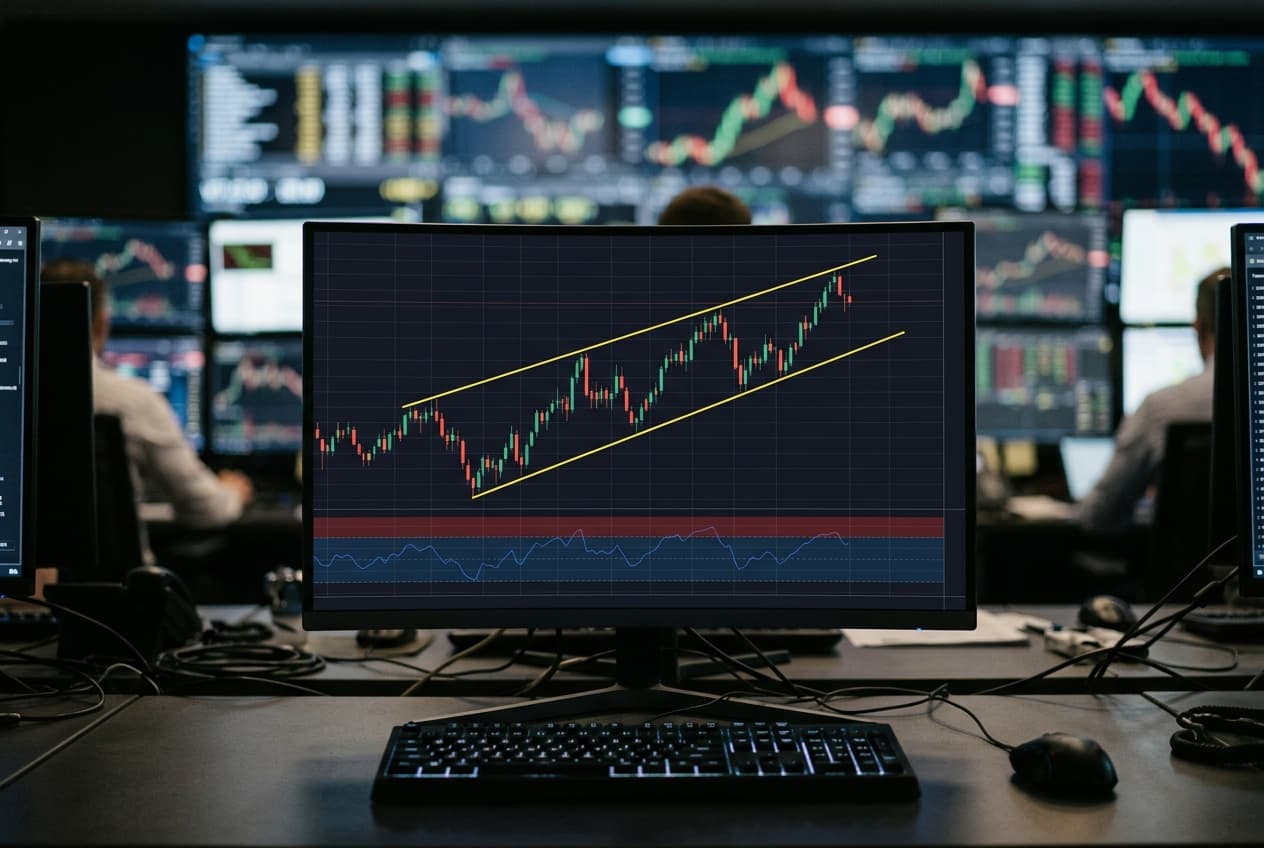
The featured pattern is the ascending channel. From the period low of $55.76 (around early February), prices have consistently posted higher highs and higher lows. The lower trendline connects approximately $55.76 → $71 → $91 (near SMA25 zones), while the upper trendline extends toward the period high of $119.48. At $112.06, the current price sits at 88.36% of the period range ($55.76–$119.48), positioned near the channel's upper boundary. Ascending channels typically see profit-taking near the upper boundary, followed by pullbacks toward the lower trendline. However, given that this surge is driven by geopolitical events, standard technical patterns may have reduced reliability.
■ Support and Resistance Levels
Pivot point analysis places the baseline at 107.84, with R1 at 118.19 and R2 at 124.31. On the downside, S1 sits at 101.72 and S2 at 91.37. Fibonacci retracement levels (based on the 55.76–119.48 range) position the 61.8% level at 95.14, 50% at 87.62, and 38.2% at 80.10. The 78.6% level at 105.84 represents a key pullback target. Ichimoku analysis shows a bullish cloud configuration, with the tenkan-sen at 99.17 and kijun-sen at 91.54 — both well below current prices, confirming trend strength.
■ Volume and Market Sentiment
Trading volume on April 2 was 514,620 contracts against a 20-day average of 498,338, yielding a ratio of 1.03 — essentially normal levels. The fact that an 11.93% surge occurred on average volume is notable, suggesting some market participants remain cautious despite the sharp move. Stochastics paint a clear overbought picture with K at 93.55 and D at 79.74.
■ Market Context and Key Drivers
The primary catalyst is the escalating Iran conflict and its impact on the Strait of Hormuz. Approximately 200 ships are stranded in the region. Drone attacks have targeted Saudi Arabian refineries and Qatari export facilities, making supply disruption risks tangible. President Trump's national address threatened further military escalation against Iran within 2–3 weeks. Meanwhile, an Iran-Oman pact was signed on April 2, introducing a diplomatic dimension. EIA data from March 27 showed crude inventories rising by 5.451 million barrels to approximately 461.64 million barrels, indicating that supply-side fundamentals are not as tight as prices suggest. Notably, oil prices plunged nearly 11% on March 23 when Trump briefly paused strikes, highlighting the fragility of the geopolitical premium.
■ Outlook and Scenarios
[Bullish] If Strait of Hormuz tensions escalate further, prices could test the period high of $119.48 and potentially R1 at $118.19 or R2 at $124.31. All timeframes confirm strong uptrend momentum.
[Bearish] A ceasefire or diplomatic breakthrough could rapidly unwind the $14–18 geopolitical premium, sending prices toward S1 at $101.72 or even SMA25 at $91.25 / S2 at $91.37. Overbought readings (RSI 71.43, Stochastic K 93.55) could amplify downside momentum.
[Neutral] If the situation remains in stalemate, prices may consolidate in a range between the Bollinger upper band at $107.90 and R1 at $118.19, with the Fibonacci 78.6% level at $105.84 serving as a pullback floor.
■ Summary
WTI crude has surged to $112.06 on geopolitical risk, positioning near the top of an ascending channel. Technical indicators show overbought conditions (RSI 71.43, Stochastic K 93.55) while trend direction remains strongly bullish across all timeframes. The outlook hinges on Iran developments, with S1 at $101.72 and R1 at $118.19 as the key levels to watch.
Disclaimer: This article is for informational purposes only and does not constitute a recommendation to buy or sell any financial instrument. Investment decisions should be made at your own risk. Crude oil futures trading involves significant leverage risk, and losses may exceed your initial investment.